
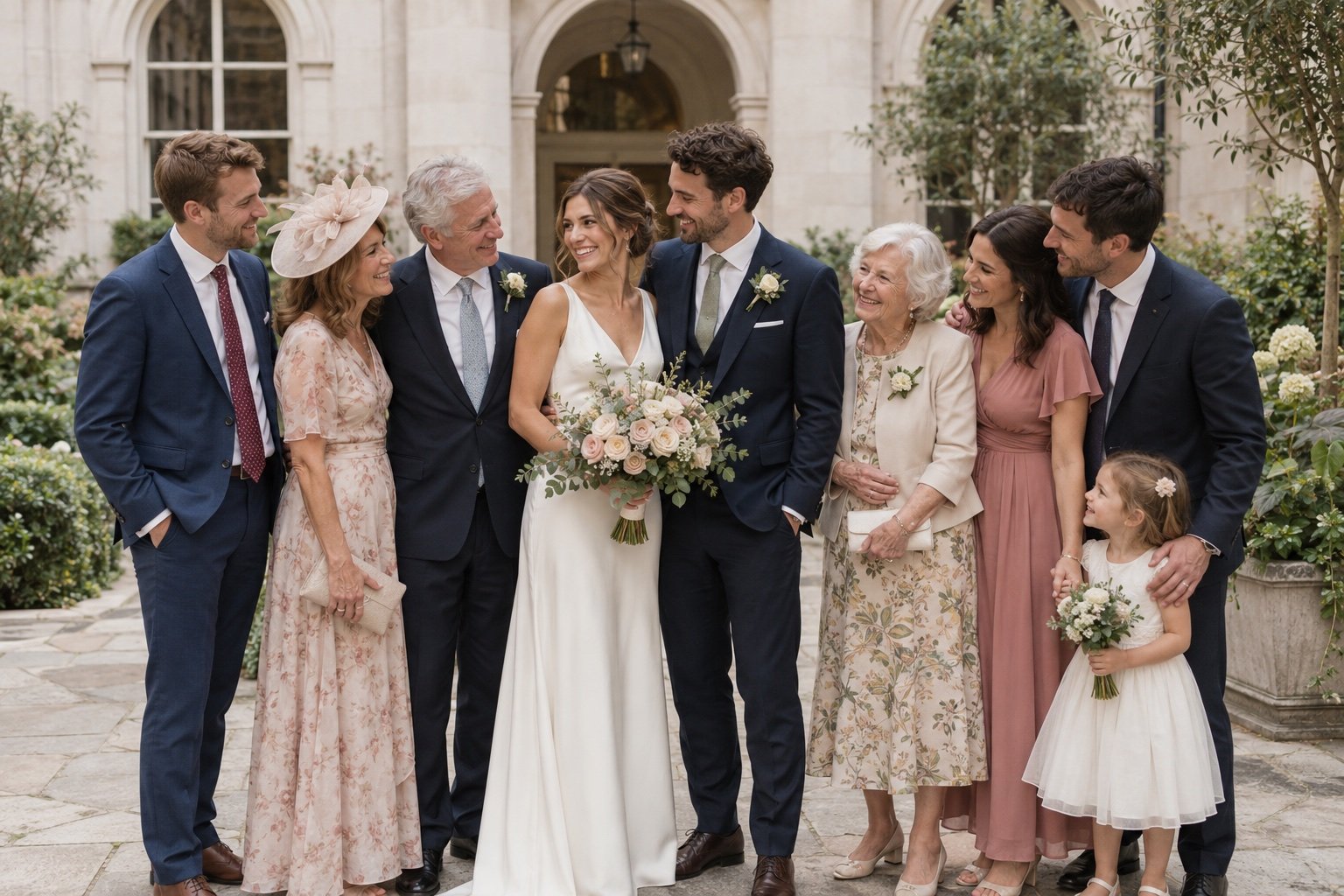
Start with photographs that will matter later
Write the list around people and relationships rather than obligation. Parents, siblings, grandparents, children and the full immediate family normally come first. Add extended groups only when there is a meaningful reason for everyone to be together.
Do not list every possible variation. A strong photograph of each close family unit is more valuable than repeating almost identical combinations while guests wait.
Use names and relationships
Write each group using names, followed by the relationship where helpful. This lets the photographer and nominated helpers communicate clearly and prevents uncertainty when surnames differ or several people share a first name.
Tell the photographer privately about bereavement, separation, mobility, strained relationships and anyone who should not stand together. Good planning avoids announcing sensitive family information in front of guests.
Build the list in an efficient order
Begin with the largest essential group while everyone is present, then release people who are no longer needed. Photograph grandparents, anyone with limited mobility and small children early. The couple can remain in position while groups change around them.
A practical sequence might move from both immediate families to one side, then the other, finishing with parents or siblings. The exact order should reflect departure times, access and the ceremony location.
- Couple with both immediate families
- Couple with one immediate family
- Couple with parents or parental figures
- Couple with siblings and their partners or children
- Couple with grandparents
- One complete group of all guests, only if the venue and timing support it
Choose the right place and time
Family photographs often work best immediately after the ceremony or confetti, before guests disperse. Choose a location with even light, enough depth and step-free access where possible. A beautiful but narrow staircase may be unsuitable for a large or mixed-mobility group.
Agree an indoor rain alternative. Moving a large family after rain begins wastes more time than selecting a covered space during planning.
Give two people responsibility for gathering groups
A photographer may not recognise every relative. Choose one organised person from each side who knows the family and is comfortable calling names. They should have the final list and begin assembling the next group before the current photograph finishes.
Avoid giving the job to someone central to every combination. A coordinator who can move freely is more useful than a parent who must remain in position.
Leave room for informal family photographs
The formal list is a safety net, not the whole family story. Hugs after the ceremony, grandparents watching the speeches and children playing often become equally important photographs.
Once essential combinations are complete, return everyone to the celebration. A concise list gives the photographer more time to notice the unscripted relationships the formal session cannot create.
How Miles Studios London can help
Miles Studios London helps every couple refine a family list before the wedding, including names, relationships, mobility considerations and any sensitive combinations. We also plan the order, location and wet-weather alternative with the wider timeline in mind.
On the day, the aim is to make essential groups efficiently and return everyone to the celebration, leaving space for the unscripted family photographs that complete the story.
Frequently asked questions
How many wedding family group photos should we request?
Around six to ten essential combinations is manageable for many weddings. Larger lists need additional time and may reduce candid or couple coverage.
How long do family photographs take?
A prepared list with helpers may take roughly three to five minutes per group, though large groups, children and mobility needs can change this.
How do we handle divorced or separated parents?
Tell the photographer privately and list acceptable combinations explicitly. Separate portraits can be arranged without drawing attention to the circumstances.
Should we take one photograph of every guest?
Only when the venue, group size and schedule make it realistic. An elevated position and clear gathering plan are normally needed.