
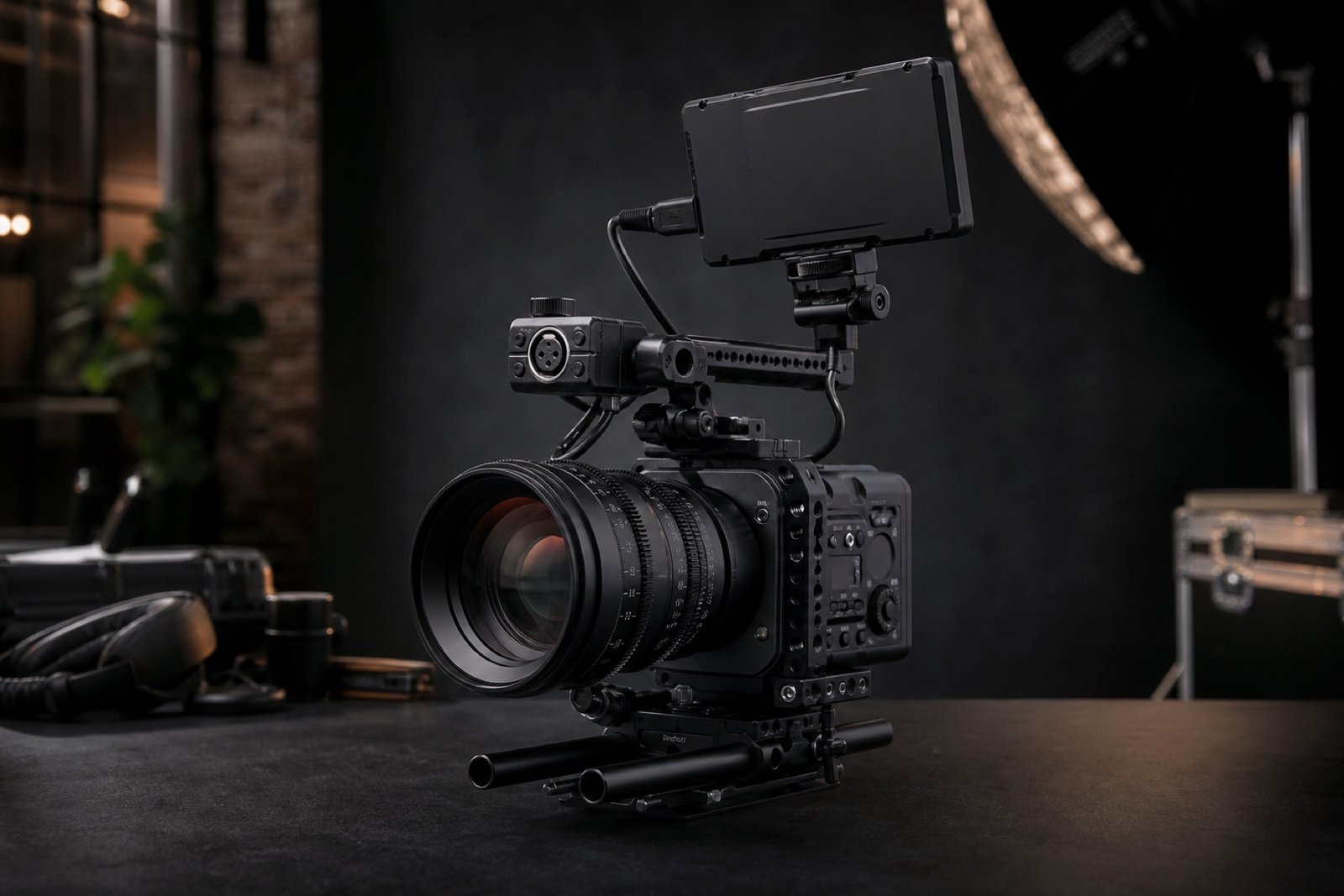
Where the FX5 sits in Sony Cinema Line
Sony's Cinema Line runs from compact creator cameras through broadcast and high-end cinema systems. The FX3 prioritises portability and familiar mirrorless operation; the FX6 adds a dedicated cinema body, electronic variable ND and set-ready connections; BURANO and VENICE move into larger crew and cinema workflows. The FX5 occupies the space between the first two rather than replacing either one.
At approximately 643 grams for the body, it remains close to the FX3 in mass, but the interface, connectivity and recording options point towards professional production. Sony's UK launch price is £4,700 body-only or £5,200 with the new XLR handle, with release planned from August 2026.
The features that genuinely change production
The full-frame stacked Exmor RS sensor records 5K and is paired with the BIONZ XR2 processor and a dedicated AI unit. Sony states more than 15 stops of latitude in S-Log3, with base ISO settings of 800, 4000 and 12800. That third high-sensitivity base is particularly useful for available-light documentary, event and night work where adding more lighting is not practical.
Internal 16-bit scene-linear X-OCN is the larger workflow shift. The FX5 records X-OCN LT, C1 and C2 without an external RAW recorder, giving productions more control over colour, exposure and VFX while offering different data-size choices. Open Gate uses the full 3:2 sensor area, which provides extra reframing room for widescreen, vertical and multiple campaign deliverables from one composition.
- 5K full-frame stacked sensor with 15+ stops stated latitude
- Internal X-OCN LT, C1 and C2 recording
- Full-frame 3:2 Open Gate capture in X-OCN
- Three base ISO settings: 800, 4000 and 12800
- AI-assisted subject recognition and up to 759 phase-detection points
- Five-axis in-body stabilisation with Active and Dynamic Active modes
Frame rates, autofocus and handheld operation
At launch the FX5 records 5K up to 60p, 4K up to 120p and Full HD up to 240p. Sony has announced a version 2.0 update for August 2027 or later that is planned to add higher-frame-rate X-OCN options, including 5K 120p and 4K 240p. Buyers should therefore evaluate the camera on the modes shipping in 2026, not purchase it solely for a future firmware promise.
AI-based human pose estimation, Real-time Tracking and eye recognition for people, animals and birds should make solo operation more dependable. Auto Tracing White Balance also uses visible-light, infrared and learned illumination data. These tools do not replace a focus puller or controlled colour workflow, but they reduce the number of technical decisions an owner-operator must manage during unrepeated moments.
Professional handling, audio and connectivity
The four-axis 3.5-inch monitor is larger and brighter than the FX3 display, while the BIG6 home screen places frame rate, shutter, exposure, white balance, ISO and LUT information around the image. Two USB-C ports, full-size HDMI, 2.5 Gigabit Ethernet, dual CFexpress Type A or SD slots and timecode input through an optional adapter support more serious production and live workflows.
The body-only model does not include built-in XLR connections. Sony's XLR-H2 handle adds two XLR/TRS inputs and up to four-channel, 96 kHz, 32-bit-float recording. That is valuable for documentary and interview teams, but it makes the complete package more expensive and the optional viewfinder cannot be used at the same time as a Multi Interface Shoe accessory such as the handle.
The limitations before you order
The FX5 does not offer the FX6's built-in electronic variable ND filter or 12G-SDI output. For fast exterior work, documentary coverage and crewed sets, internal ND and SDI can be more valuable than extra resolution. Open Gate is also limited to X-OCN at launch, so productions need suitable CFexpress media, storage, post-production performance and a clear reason to adopt RAW.
Dynamic Active stabilisation narrows the angle of view and is limited by frame rate and other settings. X-OCN lens-distortion correction is handled later in Sony's Catalyst workflow rather than baked into recorded clips. None of these points makes the camera weak, but they prevent the FX5 from being a universal replacement for an FX3, FX6 or dedicated cinema rig.
Who should buy the Sony FX5?
The strongest fit is an established filmmaker or production company already delivering commercial, documentary, music, fashion or branded work where Open Gate, internal RAW and flexible low-light capture create billable value. It also makes sense as a compact B-camera beside larger Sony cinema systems when matching colour and maintaining a small footprint matter.
An FX3 owner should upgrade when the new workflow will be used regularly, not because 5K sounds more future-proof. Social-first creators, wedding filmmakers and lean corporate teams who deliver efficient 4K may be better served by investing in lenses, sound, lighting and crew. An FX6 remains the more practical choice for operators who prioritise electronic ND, SDI and traditional cinema ergonomics. The FX5 is compelling precisely because it is specialised: a small RAW-capable cinema camera for productions that know why they need its latitude and reframing freedom.
Frequently asked questions
How much is the Sony FX5 in the UK?
Sony announced a UK price of £4,700 for the FX5 body and £5,200 with the XLR handle unit. Pre-orders opened on 22 July 2026, with release planned from August. Retail pricing may vary.
Does the Sony FX5 record Open Gate?
Yes. It is the first Sony Cinema Line FX-series camera with full-frame 3:2 Open Gate recording. At launch, Open Gate is available when recording X-OCN.
Does the Sony FX5 shoot 5K 120p and 4K 240p?
Not at launch. The shipping specification includes 5K up to 60p, 4K up to 120p and Full HD up to 240p. Sony plans higher-frame-rate X-OCN modes in a version 2.0 update scheduled for August 2027 or later.
Is the FX5 better than the FX6?
It is newer, smaller and offers internal X-OCN plus Open Gate, but the FX6 has built-in electronic variable ND, 12G-SDI and production-camera ergonomics. The better camera depends on whether RAW flexibility or set-ready operation matters more.