
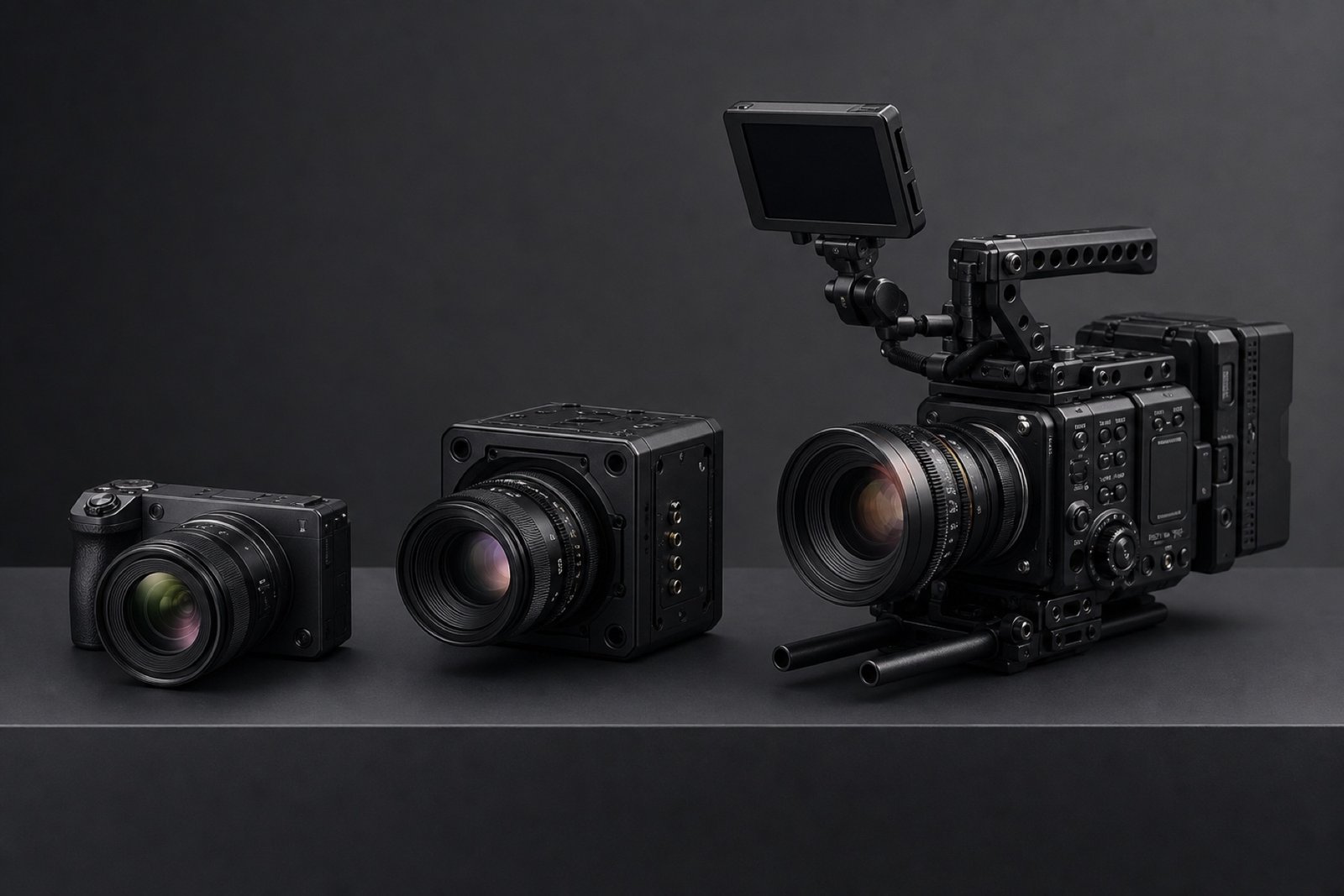
Sony FX3: the compact 4K workhorse
The FX3 remains the most straightforward choice for filmmakers who need a tiny full-frame body with 4K up to 120p, five-axis stabilisation and strong autofocus. It works particularly well on gimbals, car rigs, travel productions, weddings and small brand shoots where speed and discretion matter more than a traditional cinema-camera layout.
Its 12.1-megapixel full-frame sensor and 15+ stop stated latitude remain capable, while the supplied XLR handle on common UK configurations solves basic professional audio. The compromise is workflow expansion: RAW is output over HDMI rather than recorded internally, there is no Open Gate mode, and the small display and control layout can feel restrictive once the camera is heavily rigged.
Sony FX5: compact body, cinema-data workflow
The FX5 keeps a body-only mass close to the FX3 while introducing a stacked 5K sensor, internal X-OCN, full-frame 3:2 Open Gate and three base ISO settings. It is the choice for filmmakers who want a compact camera but need more latitude in post, multiple aspect-ratio deliveries or a RAW workflow without an external recorder.
Its larger four-axis screen, BIG6 interface, 2.5 Gigabit Ethernet and optional 32-bit-float XLR handle move it towards professional production. However, its body has HDMI rather than SDI and no built-in electronic variable ND. A matte box, screw-in filters or external ND solution may still be necessary.
Sony FX6: built for the working set
The FX6 is larger, but the extra space supports the features crews use repeatedly: built-in electronic variable ND from 1/4 to 1/128, 12G-SDI, BNC timecode, dedicated audio, a proper top handle, assignable controls and BP-U battery options. These reduce setup time and make exposure changes smoother during documentary, broadcast, commercial and multicamera work.
The FX6 records 4K up to 120p and offers more conventional cinema ergonomics, but it lacks the FX5's 5K Open Gate and internal X-OCN. It also does not provide sensor-shift in-body stabilisation. For tripod, shoulder and crewed work, those omissions may matter less than dependable connections and internal ND.
The comparison that matters on a real job
Start with the repeated constraint in your work. If the camera lives on a gimbal or must fit in a small bag, the FX3 is difficult to beat. If clients request horizontal, square and vertical edits from the same material, FX5 Open Gate can protect composition and reduce duplicate takes. If lighting changes quickly and video village expects SDI, the FX6 will usually operate more cleanly.
Media and post-production are part of the decision. X-OCN gives the FX5 greater flexibility, but it increases storage, backup and computing requirements. A camera that records a technically superior format is not more profitable if the production cannot manage the data efficiently.
- FX3: smallest body, IBIS, efficient 4K delivery and gimbal work
- FX5: 5K Open Gate, internal X-OCN, IBIS and flexible multi-format capture
- FX6: electronic variable ND, 12G-SDI, timecode BNC and cinema ergonomics
Which camera suits each type of filmmaker?
Solo creators, wedding filmmakers, travel shooters and compact branded-content teams will often achieve the best return from the FX3. Documentary owner-operators, music and fashion filmmakers, VFX-aware teams and commercial studios that need RAW or Open Gate are the clearest FX5 audience.
The FX6 remains a strong choice for documentary crews, agencies, broadcast work, interviews, live production and sets where assistants, wireless video and professional timecode are normal. Some companies will use an FX6 as the main camera and an FX3 or FX5 as the mobile second body rather than trying to make one camera perform every role.
Our practical verdict
Do not choose by resolution alone. The FX3 is the value and mobility decision, the FX5 is the image-data and reframing decision, and the FX6 is the operational decision. List the accessories required to make each body production-ready, then compare the complete package rather than the camera price.
For a new professional buyer in 2026, the FX5 is the most interesting all-round proposition when internal RAW will genuinely be used. Existing FX3 owners should keep working unless Open Gate or X-OCN solves a recurring delivery problem. Existing FX6 owners have little reason to replace a set-ready body; the FX5 is more persuasive as a compact companion.
Frequently asked questions
Is the Sony FX5 a replacement for the FX3?
No. The FX3 remains smaller in concept and is a strong choice for efficient 4K and gimbal work. The FX5 adds 5K Open Gate, internal X-OCN and more production connectivity for filmmakers who need those workflows.
Why choose an FX6 over the newer FX5?
Choose the FX6 for built-in electronic variable ND, 12G-SDI, BNC timecode, dedicated audio and traditional cinema ergonomics. Those features can save more time on set than the FX5's extra resolution.
Can footage from FX3, FX5 and FX6 be matched?
Yes. All three support S-Cinetone and S-Log3-based workflows, but matching still requires consistent exposure, white balance, lenses, monitoring and grading.
Which Sony Cinema Line camera is best for a solo filmmaker?
The FX3 is the simplest compact option. The FX5 is better for a solo operator who needs internal RAW, Open Gate or stronger network tools and is prepared for the additional media and post-production load.